Markets · 3 Nov 2026Policy rateBank of Canada2.50%YieldsCA 2Y3.26%CA 5Y3.49%+3 bpCA 10Y3.77%+3 bpCanadian dollarCAD/USD0.7146−0.11%CAD/EUR0.6385−0.02%CAD/GBP0.5325−0.15%CAD/JPY113.25+0.34%CryptoBTCUS$80,269+3.46%ETHUS$2,423+5.57%

Morning Brief

Wednesday 23 September 2026

Bank of Canada Governor Tiff Macklem said on Monday that the latest U.S. tariffs, which cover about 5% of Canada’s goods exports to the United States, could cut fourth-quarter growth to below 1%, while inflation sits near 3% on fuel prices.

The desk’s view todayThe Bank of Canada holds at 2.25% on 28 October, and the tariff slowdown Macklem described does not bring a cut forward while inflation sits at 3%.

Story 1 of 5

Macklem says the new U.S. tariffs could cut Canada’s fourth-quarter growth to below 1%
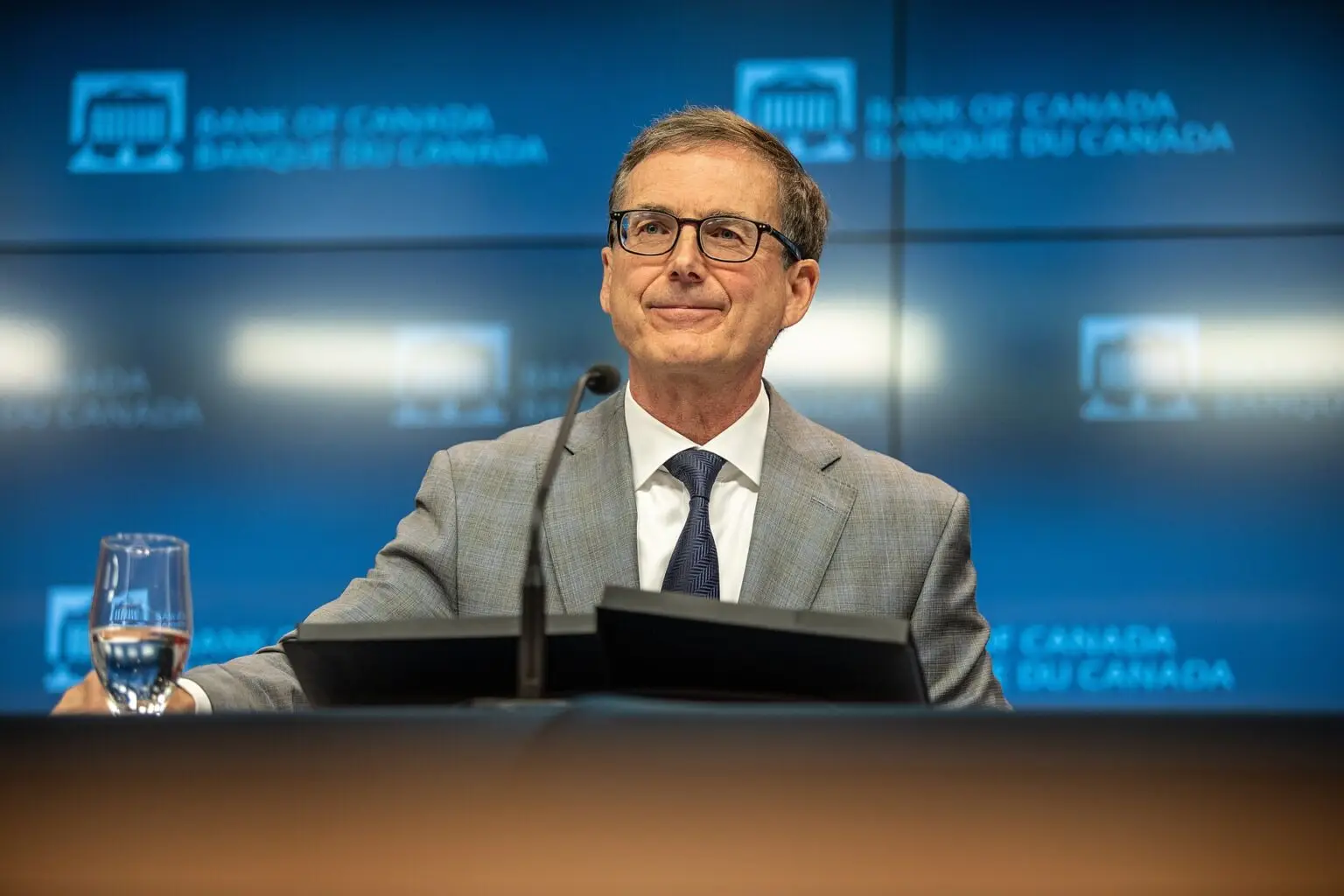
Tiff Macklem, Governor of the Bank of Canada, speaking at a Bank of Canada event
Photo: Bank of Canada - Banque du Canada from Canada, CC BY 2.0, via Wikimedia Commons

01What happened

Bank of Canada Governor Tiff Macklem spoke to the Halifax Partnership on Monday 21 September, and the speech had two halves. The first was a recovery report: GDP grew at a 3.3% annualised pace in the second quarter, non-energy exports rose 14.5% in the quarter to their highest level since early 2025, business investment rose at an 8.8% annualised rate, and the unemployment rate has edged down to 6.4%. Almost one in five Canadian businesses now uses AI to make goods or deliver services, about triple the share of two years ago.

The second half was a warning. The latest U.S. tariffs cover products worth about 5% of Canada’s goods exports to the United States, and if they stay in place Macklem said growth could be roughly halved in the fourth quarter, to below 1%. On prices, CPI inflation has sat around 3% for four months, mostly because of fuel: every 10% rise in oil adds about 0.2% to CPI, and because of damaged refining capacity, pump prices have behaved as if oil were almost US$40 a barrel higher than it is. If oil stays near US$100, he expects inflation to edge up in the coming months. The overnight rate has been 2.25% since the 2 September hold, and the next decision is 28 October, alongside a new Monetary Policy Report.

02Our view

The Bank of Canada holds at 2.25% on 28 October. We think its next move is still more likely to be a cut than a hike, but not before CPI ex-gasolineCPI ex-gasoline The Consumer Price Index with gasoline removed. When it sits well below the headline rate, the inflation is coming from fuel rather than from the broad economy. has stopped climbing, so variable-rate relief stays paused through the winter.

Why we think so. Governor Macklem’s speech had two halves, and they pull in opposite directions. The recovery is real: GDP grew at a 3.3% annualised pace in the second quarter, non-energy exports rose 14.5% to their highest level since early 2025, business investment rose at an 8.8% annualised rate and unemployment edged down to 6.4%. The warning is also real: the latest U.S. tariffs cover about 5% of Canada’s goods exports to the United States, and if they stay, growth could be roughly halved in the fourth quarter, to below 1%. A tariff slowdown argues for lower rates eventually, but it arrives slowly. Inflation of 3% is here now. CPI has sat around 3% for four months, mostly because of fuel; every 10% rise in oil adds about 0.2% to CPI, and damaged refining capacity has made pump prices behave as if oil were almost US$40 higher than it is. With ex-gasoline inflation at 2.4% in August and the Bank saying the upside risks to inflation have grown, a cut now would lean against its own forecast. A tariff shock that halves growth also removes any case for following the Fed higher. That leaves a hold.

What the market is pricing. The consensus for 28 October is a hold at 2.25%, and we agree. Where we take a view is on direction afterwards: the slowdown Macklem described tilts the next move toward a cut, but only once the inflation numbers allow it.

What it means. For a household with a variable-rate mortgage, a line of credit or anything priced off prime rate, the relief of the past two years has paused, and the Bank is not promising when it resumes. Budget on today’s rate through the winter rather than on a cut. For a business that sells into the United States, 5% of national exports sounds small, but the tariffs land on a few sectors, and within those sectors the hit is the whole margin, not 5% of it. Check whether your products sit inside the tariffed categories and decide now how much of the cost can be passed on; the customer conversation is easier before the invoice than after. The broader planning question is how much income or revenue depends on a U.S. buyer, and whether the budget balances if rates stay put for another year while fuel stays expensive.

What would change our mind. A September CPI reading in mid-October with ex-gasoline inflation above 3% would put a hike on the table. A Labour Force Survey showing job losses spreading beyond the tariffed sectors, or the 5-year yield falling below 3.3%, would bring a cut forward. We would say so.

What to watch. The September CPI in mid-October, the price of oil as the UN General Assembly week unfolds, and the 28 October decision with its new Monetary Policy Report. There is no major Canadian release today.

03Why it matters to you

If you carry a variable mortgage or a line of credit, tariffs and fuel are pulling rates in opposite directions. Knowing your payment under either path helps you plan.

Book a mortgage renewal review

Sources Bank of Canada, Navigating uncertainty and adapting to change, speech by Governor Tiff Macklem, Halifax; The Canadian Press (via Yahoo Finance Canada), Bank of Canada governor warns new tariffs could cut fourth-quarter growth in half; BNN Bloomberg, Macklem says U.S. trade unpredictability could set back recent economic progress; Bank of Canada, Bank of Canada maintains the policy rate at 2¼%; TD Economics, Canadian Consumer Price Index (August 2026)


Story 2 of 5

Canadian yields eased from their highs, but the 5-year is still 3.54% and the dollar is 71 cents

A market price chart on a phone screen
Photo: Pexels

01What happened

Bank of Canada benchmark yields closed Tuesday 22 September at 3.25% for the 2-year, 3.54% for the 5-year, 3.83% for the 10-year and 4.15% for the long bond. That is a few basis points below the 18 September close of 3.32%, 3.59% and 3.87% recorded in our market feed, but the 5-year, the benchmark for fixed mortgage pricing, is still about 19 basis points higher than a month ago. Early Wednesday the 10-year was trading back up near 3.86%.

The pressure comes from the United States. On 16 September the Federal Reserve raised its target range to 3.75% to 4.00%, its first increase in more than three years, on a unanimous vote, citing persistent energy and consumer price pressure. The U.S. 10-year Treasury bond yieldBond yield The annual return an investor gets for lending to a government or company through a bond. Yields rise when bond prices fall. Fixed mortgage rates are priced from the 5-year Government of Canada yield. topped 5% last week for the first time since 2023 and closed Tuesday at 4.95%, against 3.97% before the Iran war began.

The Canadian dollar closed Tuesday at 71.10 U.S. cents, from 71.32 cents on Monday, a seven-week low. Our feed’s data of record is the Bank of Canada’s 21 September rate of 0.7132. Bitcoin was US$86,039 on Tuesday morning, up 1.5% in 24 hours, and Ethereum US$2,744.

02Our view

The Canada-U.S. rate gap is now the single biggest force on the dollar. We expect it to trade between 70 and 72 U.S. cents until the Fed signals it is finished or the Bank of Canada turns hawkish, neither of which we expect before November, with five-year fixed mortgage rates holding in the low-4% range.

Why we think so. Money tends to move toward the higher interest rate. On 16 September the Federal Reserve raised its target range to 3.75% to 4.00%, its first increase in more than three years, on a unanimous vote, citing persistent energy and consumer price pressure. Against a Bank of Canada rate of 2.25%, that is a gap of about 150 to 175 basis points, which is why the dollar keeps slipping: it closed Tuesday at 71.10 U.S. cents, a seven-week low. The same force sets Canadian bond yields. The U.S. 10-year Treasury bond yieldBond yield The annual return an investor gets for lending to a government or company through a bond. Yields rise when bond prices fall. Fixed mortgage rates are priced from the 5-year Government of Canada yield. topped 5% last week for the first time since 2023 and closed Tuesday at 4.95%, against 3.97% before the Iran war began. Canadian benchmark yields eased only slightly, to 3.25% for the 2-year, 3.54% for the 5-year and 3.83% for the 10-year, and early Wednesday the 10-year was back near 3.86%. The 5-year, the benchmark for fixed mortgages, is still about 19 basis points higher than a month ago.

What the market is pricing. The shape of Canadian yields says the bond market is not expecting rate cuts soon. A 2-year yield of 3.25% sits a full point above the 2.25% overnight rate; if investors expected the Bank to cut over the next two years, that yield would be closer to or below the policy rate. We agree with that reading. The small easing since the 18 September close of 3.32%, 3.59% and 3.87% is a pause, not a turn.

What it means. For borrowers, a 5-year yield near 3.5% keeps five-year fixed quotes in the low-4% range. A mortgage renewal or purchase closing within 120 days is a reason to ask for a rate hold now; it costs nothing and protects against the direction yields have moved. A dollar at 71 cents makes U.S. travel, U.S.-dollar subscriptions and imported goods cost more. Anyone with known U.S.-dollar spending ahead, a winter in the south or a child’s U.S. tuition, can buy the dollars in monthly tranches rather than in one lot at whatever the rate happens to be in January. The weak dollar also makes an exporter’s U.S. sales, and a Canadian’s U.S. investments, worth more in Canadian terms. The useful household question is whether U.S.-dollar spending and U.S.-dollar investments roughly offset each other, or both point the same way.

What would change our mind. The 5-year yield back below 3.3%, or the dollar holding above 73 cents for two weeks. Either would mean the market has decided the Fed is done.

What to watch. Today’s U.S. flash PMIs for September (consensus 53.6 manufacturing, 55.8 services), any Fed signal on whether it is finished, the Canadian September CPI in mid-October and the Bank of Canada on 28 October.

03Why it matters to you

If you are renewing, buying a GIC or holding bonds, Washington is setting your rates. A review helps you choose terms with that in mind.

Book a mortgage renewal review

Sources Bank of Canada, Selected bond yields, 22 September 2026 close; Ascenthya market feed, Bank of Canada Valet and CoinGecko data, last good copy fetched 22 September 04:42 PT; U.S. Federal Reserve, Implementation Note issued September 16, 2026; Raisin, Fed Rate Decision September 2026: Benchmark Hiked to 3.75%-4.00%; The Associated Press (via Spectrum News), Wall Street ticks to the edge of its record as Brent oil falls toward $98 per barrel; The Canadian Press (via BNN Bloomberg), S&P/TSX composite rises more than 300 points, U.S. stock markets mixed; Investing.com, Canada 10-year yield climbs as bond selling resumes; Knightsbridge FX, Canadian Dollar Update, September 22, 2026

Story 3 of 5

Oil slipped toward US$98 on talk of U.S.-Iran contact at the UN, but the strait is still not open

A crude oil tanker moored at Port Arthur, Texas
Photo: Quintin Soloviev, CC0, via Wikimedia Commons

01What happened

Brent crude fell 1.9% on Tuesday to US$98.46 a barrel, down from nearly US$110 last week but still far above the roughly US$72 it traded at before the war with Iran began about seven months ago. The November West Texas Intermediate contract settled down US$1.85 at US$90.52. The trigger was diplomacy: President Trump used his address to the UN General Assembly on Tuesday to defend the war and to accuse Iran of dragging out talks on fully reopening the Strait of Hormuz until after the U.S. midterm elections, while Secretary of State Rubio said Trump remained open to meeting Iranian President Pezeshkian in New York. Tehran has hinted at talks.

Two other supply problems sit behind the headline: a Saudi pipeline closure and Houthi gains near shipping lanes. And as Governor Macklem noted on Monday, damaged refining capacity means Canadian pump prices have been behaving as if crude were almost US$40 higher than the quoted barrel.

02Our view

A Trump-Pezeshkian handshake would take US$5 to US$10 off the barrel in a day, but the price that matters for a household budget is set by tanker traffic, not photographs. We expect Brent to stay between US$90 and US$105 until traffic through the Strait of Hormuz is verifiably back to normal for a sustained period.

Why we think so. Tuesday’s fall was driven by diplomacy rather than supply. Brent fell 1.9% to US$98.46 a barrel, down from nearly US$110 last week, and the November WTI contract settled down US$1.85 at US$90.52. The trigger was talk of contact at the UN: President Trump used his General Assembly address to defend the war and to accuse Iran of dragging out talks on reopening the strait until after the U.S. midterm elections, while Secretary of State Rubio said Trump remained open to meeting Iranian President Pezeshkian in New York, and Tehran has hinted at talks. Nothing physical has changed. The strait is still not open, a Saudi pipeline is closed and Houthi forces have made gains near shipping lanes. The price is still far above the roughly US$72 it traded at before the war began about seven months ago.

The bigger picture. Oil futures react within minutes to diplomatic headlines, because traders price the chance of a deal. The physical supply that households and businesses actually buy recovers far more slowly: ships must return, insurers must be satisfied and damaged infrastructure repaired. That is why a headline can knock several dollars off the price in a day while the range holds for months. In Canada, refining adds a second layer. As Governor Macklem noted, damaged refining capacity has made pump prices behave as if crude were almost US$40 higher than the quoted barrel, so even a lower crude price may not reach the pump quickly.

What it means. Canadian inflation is at 3% mostly because of fuel, and by the Bank of Canada’s rule of thumb a 10% rise in oil adds about 0.2% to CPI. For households, the fuel line of the budget should be set on today’s pump price rather than a peace-deal price, and a vehicle purchase or longer commute is best tested at today’s price plus 10%. A business that ships or delivers should check whether customer contracts allow fuel surcharges to pass through and whether its suppliers can pass theirs on. Borrowers should read high fuel prices as one reason the Bank is holding. For investors, the offset is narrow but real: Alberta’s revenues, the energy weight in the TSX and the dollar all benefit from a high barrel.

What would change our mind. Two consecutive weeks of near-normal tanker transits, or Brent holding below US$85. Either would mean the market has decided the supply regime has changed.

What to watch. Any U.S.-Iran contact at the UN General Assembly, today’s U.S. EIA weekly crude inventories (consensus a draw of 0.7 million barrels), the Canadian September CPI in mid-October and the Bank of Canada on 28 October.

03Why it matters to you

If fuel and groceries are stretching your budget, a lower oil price takes weeks to reach the pump and months to reach the shelf. Planning for the lag keeps the budget realistic.

Book a budget and savings check

Sources The Associated Press (via Spectrum News), Wall Street ticks to the edge of its record as Brent oil falls toward $98 per barrel; The Canadian Press (via BNN Bloomberg), S&P/TSX composite rises more than 300 points, U.S. stock markets mixed; The Associated Press (via OPB), Trump in address to world leaders at UN defends his decision to start war against Iran; Bank of Canada, Navigating uncertainty and adapting to change, speech by Governor Tiff Macklem, Halifax; TheStreet, Stock Market Today (Sept. 22, 2026): Russell 2000, Nasdaq rise as oil prices sink and tech stocks rise

Story 4 of 5

The TSX rose 326 points and the Nasdaq set a record as the AI trade came back

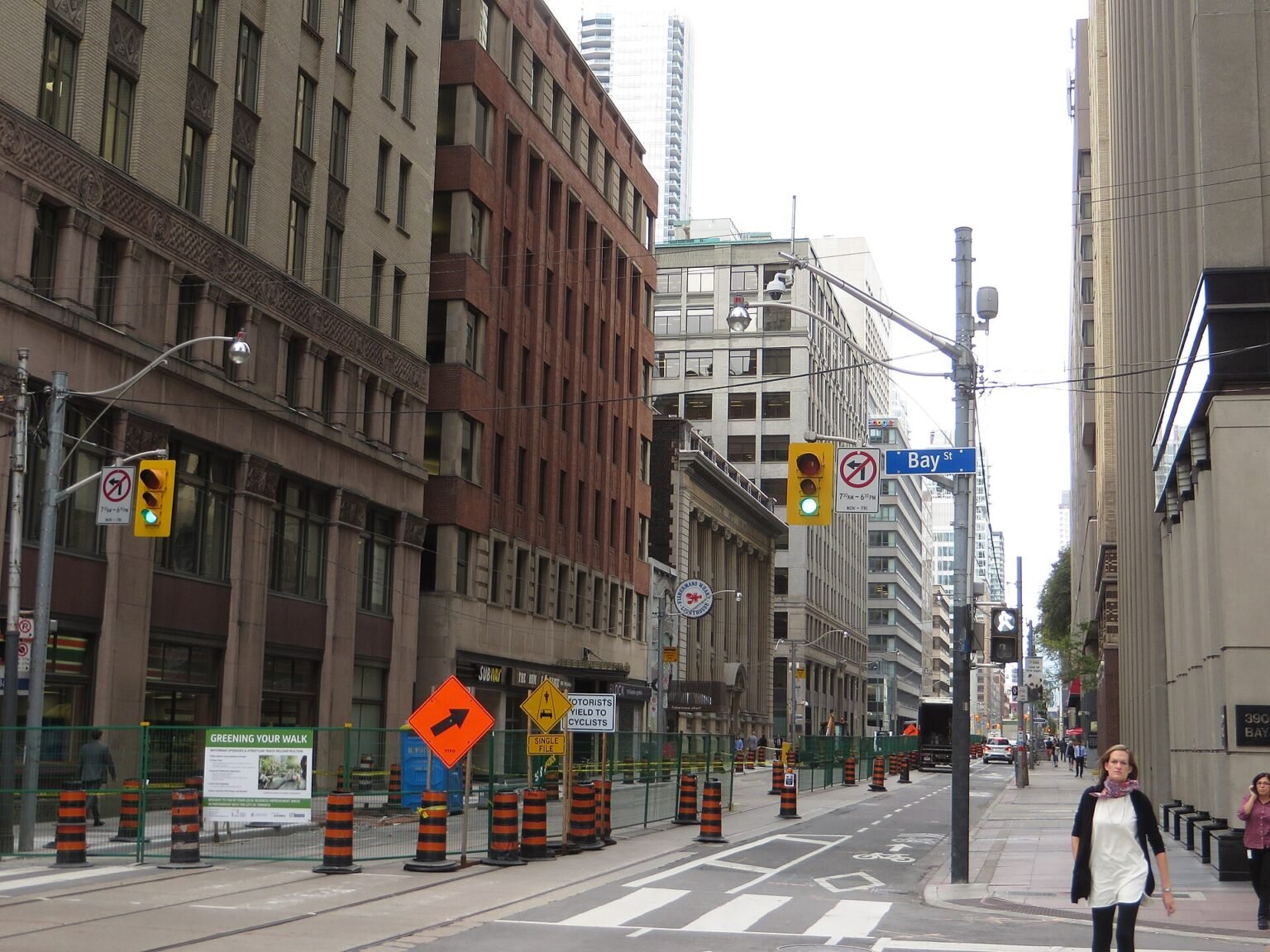
Bay Street in Toronto’s financial district
Photo: Ken Lund from Reno, Nevada, USA, CC BY-SA 2.0, via Wikimedia Commons

01What happened

The S&P/TSX Composite gained 326.21 points on Tuesday to close at 36,335.61, led by materials and technology, after a 203-point gain on Monday that took it to its highest level in nine sessions. In New York the Nasdaq rose 122.18 points to a record 27,244.28, the S&P 500 was flat at 7,764.64, the Dow fell 185.14 points to 51,863.69 and the Russell 2000 small-cap index rose 0.7%. December gold settled down US$7.50 at US$4,376.40 an ounce.

The driver was AI again. Meta shares rose nearly 12% on Monday after its Muse agent app reached 2.8 million installs in its first 12 days, launched only in the United States and Canada, ahead of the pace ChatGPT set on mobile; Intel rose 12% and AMD 10% the same day, taking AMD to a US$1 trillion valuation. Third-quarter earnings season opens in mid-October, and S&P 500 companies are expected to report profit growth of about 29% on the year.

02Our view

This rally is backed by earnings, not just enthusiasm, but it is narrow. We would neither add to technology exposure at a record on the strength of an app launch nor sell a diversified portfolio because of one; the test is October’s earnings season.

Why we think so. The gains were real and concentrated. The S&P/TSX Composite rose 326.21 points on Tuesday to 36,335.61, led by materials and technology, after a 203-point gain on Monday. In New York the Nasdaq rose to a record 27,244.28, while the S&P 500 was flat at 7,764.64 and the Dow fell 185.14 points. The driver was AI: Meta shares rose nearly 12% on Monday after its Muse agent app reached 2.8 million installs in its first 12 days, and Intel and AMD rose 12% and 10% the same day, taking AMD to a US$1 trillion valuation. Profits support part of this: S&P 500 companies are expected to report profit growth of about 29% on the year in the third quarter. But a record set while the U.S. 10-year yield sits near 5% is a market that has decided earnings will deliver.

What the market is pricing. Expected profit growth of about 29% is a high bar. When bonds pay close to 5%, shares have to justify their prices through earnings, and the stocks that have risen most on expectations have the least room for disappointment. If results deliver, the rally holds; if they do not, the sectors that led are the sectors that fall first. The TSX gain is broader and quieter, with energy holding up on a US$90 barrel, which makes it less dependent on a single theme.

What it means. Most Canadian portfolios are now more American than Canadian, and through index funds they are more concentrated in a few technology names than their owners usually realise. The practical check is what share of the portfolio sits in the ten largest U.S. technology companies, counting what is inside index funds and balanced funds. If it is higher than a share you chose deliberately, rebalancing inside an RRSP or TFSA costs nothing in tax; in a taxable account, the capital gains cost of trimming should be weighed against the concentration. The broader discipline is a written target asset mix with a rule for when to rebalance back to it, so the decision is not made at a record high or at a bottom. For business owners whose own company is exposed to technology spending, the same concentration may already exist outside the portfolio.

What would change our mind. A run of results showing AI capital spending without matching revenue growth, or corporate credit spreads widening. Either would make this a valuation story rather than an earnings one.

What to watch. Today’s U.S. flash PMIs for September, the start of third-quarter earnings season in mid-October, and the Bank of Canada on 28 October.

03Why it matters to you

If your portfolio is more American and more concentrated than you realise, a record day hides risk as well as reward. A review shows what you actually hold.

Book a portfolio review

Sources The Canadian Press (via BNN Bloomberg), S&P/TSX composite rises more than 300 points, U.S. stock markets mixed; TheStreet, Stock Market Today (Sept. 22, 2026): Russell 2000, Nasdaq rise as oil prices sink and tech stocks rise; The Associated Press (via Spectrum News), Wall Street ticks to the edge of its record as Brent oil falls toward $98 per barrel; Zacks (via Yahoo Finance), Stock Market News for Sep 22, 2026; TechCrunch, Meta’s Muse is outpacing ChatGPT’s early mobile launch; The Motley Fool Canada, TSX Today: What to Watch for in Stocks on Tuesday, September 22

Story 5 of 5

One in five Canadian businesses uses AI, and job-finding is slowing in the occupations most exposed to it

Desks and computers in an open plan office
Photo: VeronicaTherese, CC BY-SA 3.0, via Wikimedia Commons

01What happened

Buried in Governor Macklem’s Halifax speech on Monday was a labour-market observation worth more than its one line. Citing Statistics Canada, he said almost one in five Canadian businesses had used AI to produce goods or deliver services in the previous 12 months, roughly three times the share of two years earlier. Private-sector hiring has strengthened and unemployment has edged down to 6.4%, but job-finding rates have declined in the occupations most exposed to AI. Business investment rose at an 8.8% annualised rate in the second quarter as firms spent to raise productivity.

The consumer side of the same story arrived the same day: Meta’s Muse agent, released only in the United States and Canada, recorded 2.8 million installs in 12 days and about 642,000 U.S. daily active users, nearly three times ChatGPT’s at the same point in its launch.

02Our view

AI’s first financial effect on Canadian households will be longer job searches in exposed occupations rather than mass layoffs. Over the coming year, the useful response is liquidity, not prediction.

Why we think so. Governor Macklem’s Halifax speech, citing Statistics Canada, gave the evidence in a single line. Almost one in five Canadian businesses used AI to produce goods or deliver services in the previous 12 months, roughly three times the share of two years earlier. Over the same period private-sector hiring has strengthened and unemployment has edged down to 6.4%, so AI is not showing up as job losses across the economy. It is showing up in job-finding rates, which have declined in the occupations most exposed to it. That is the pattern you would expect when firms adopt a new tool: rather than dismissing staff, they hire fewer people for the tasks the tool can now handle, and those already looking for that kind of work wait longer. Business investment rose at an 8.8% annualised rate in the second quarter as firms spent to raise productivity, which points the same way.

The bigger picture. New technologies have usually reached workers first through hiring rather than firing. Adoption spreads gradually, firms let attrition do the work, and the change becomes visible in who gets hired and how long it takes. The consumer side is moving fast too: Meta’s Muse agent, released only in the United States and Canada, recorded 2.8 million installs in 12 days and about 642,000 U.S. daily active users, nearly three times ChatGPT’s at the same point. When adoption runs this quickly, the gap between technology and hiring practices can open quickly as well.

What it means. The effect is not a layoff headline. It is a longer job search for people in administrative, customer-service, junior analytical and some technical roles, which shows up in a household budget as months without income. If AI tools already do part of your job, size the emergency fund at six months of expenses rather than three, and hold it somewhere it earns interest, such as a high-interest savings account or a short GIC ladder. Check how long group benefits or private coverage would replace income if a search ran long. The planning question is how many months the household could run on one income or none, and whether that number was set when jobs were easy to find. For a business owner, AI is both a cost and a competitive pressure; for a parent, it is a question about what a teenager should train for. None of this is a reason for alarm.

What would change our mind. Job-finding rates in AI-exposed occupations recovering over the next two Labour Force Surveys, or unemployment rising across all occupations. Either would make this an ordinary slowdown rather than a structural shift.

What to watch. The next two Labour Force Surveys, and the Bank of Canada’s 28 October decision and Monetary Policy Report for any further comment on AI and the labour market.

03Why it matters to you

If your work is in administration, customer service or junior analysis, AI is lengthening job searches. Knowing how long your savings and cover would last is worth checking.

Book an income protection check

Sources Bank of Canada, Navigating uncertainty and adapting to change, speech by Governor Tiff Macklem, Halifax; Bank of Canada, Bank of Canada maintains the policy rate at 2¼%; TechCrunch, Meta’s Muse is outpacing ChatGPT’s early mobile launch

Today’s news, considered against your own plans.

If one of these stories bears on your mortgage, savings, income or business, we would be glad to go through it with you and explain clearly what, if anything, it means for you.

Book a conversation

Free · optional

The Morning Brief in your inbox at 06:00 Pacific.

The day’s stories, what each means for you, and our view. Unsubscribe in one click.

Email subscriptions open shortly.